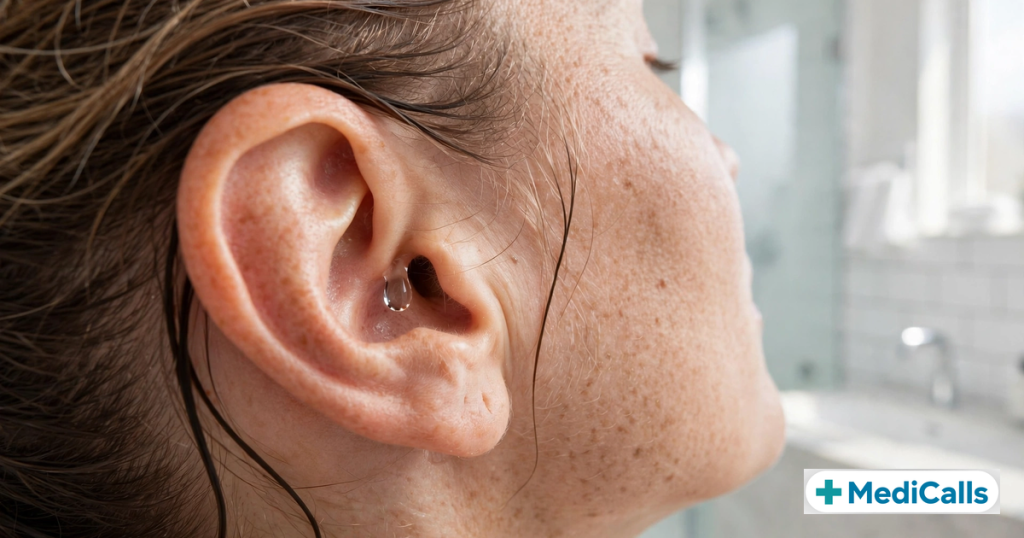
QUICK ANSWER: Water trapped in your ear after a shower or swim is usually harmless and drains out on its own — tilt your head, tug your earlobe, and try the “hop and shake” first. Most people clear it within a few minutes.

Step 1: Tilt, Tug, and Hop

Tilt your head so the blocked ear faces the floor. Gently tug your earlobe down and back — this straightens the ear canal and gives the trapped water a clear path out. Now hop on one foot on the side of the blocked ear, tapping the top of your head with your palm at the same time. Gravity and motion do most of the work here.
Step 2: Create Gentle Suction
Place the flat of your palm over the blocked ear and press in, then release quickly — a few soft pumping motions. This creates light suction that can pull water out of the canal. It should feel like a mild “pop”, not pain. Stop immediately if anything hurts.
Step 3: Dry It With Warm Air

Tilt your head and let warmth reach the canal: set a hair dryer to its LOWEST heat setting, hold it at least 30 cm (about a foot) away, and blow warm air toward the ear for 30 seconds at a time. Or simply lie on your side on a warm (not hot) towel — trapped water drains and evaporates as the canal warms up.
Step 4: Try the Gentle “Pop” (Valsalva)
Close your mouth, pinch your nose shut, and blow very gently — as if blowing your nose softly — until you feel a faint pop in the ear. Keep it gentle: forceful blowing can injure your eardrum. Skip this step if you have a cold, sinus infection, or an ear infection.
Step 5: Drying Drops (Optional)
If water is still there after 15–20 minutes, a pharmacy “swimmer’s ear” drop — or a homemade 1:1 mix of rubbing alcohol and white vinegar — can help: alcohol helps the water evaporate and vinegar discourages bacteria. Tip your head, place 2–3 drops in, wait 30 seconds, then tilt to drain. Follow the pack directions on any store-bought drop. Skip this step entirely if your eardrum might be perforated (see the warning signs below).
What NOT to do
- Do NOT push a cotton bud (Q-tip) into your ear — it pushes water and wax deeper and can scratch the canal.
- Do NOT use your fingernail, keys, pen caps, or any sharp object to “dig” the water out.
- Do NOT blow a hair dryer on high heat close to your ear — burns happen fast.
- Do NOT ignore water that stays stuck for more than 2–3 days — stagnant water can lead to a swimmer’s ear infection.
See a doctor / seek urgent care if:
- The water has been stuck for more than 2–3 days
- You develop pain, itching, redness, or swelling in or around the ear
- You notice discharge, a foul smell, or a fever
- Your hearing feels muffled or you feel dizzy
- You suspect a perforated eardrum (sudden sharp pain, bleeding from the ear, or a recent ear injury or infection)
FAQs
Is water stuck in the ear dangerous?
Usually no. The ear canal drains on its own within minutes to hours. It becomes a problem only if water sits for days, creating a moist environment where bacteria can grow (swimmer’s ear, or otitis externa).
Can I sleep with water in my ear?
Yes — lie on the affected side on a clean towel or pillow. Overnight warmth and gravity often clear it by morning. If it is still there with no improvement, try the steps above again.
Does shaking or hopping my head really work?
For most people, yes. The combination of gravity (head tilt), a straightened canal (earlobe tug), and motion breaks the water’s surface tension and lets it flow out. It is the first thing swim coaches recommend.
This guide is for information only and is not medical advice.