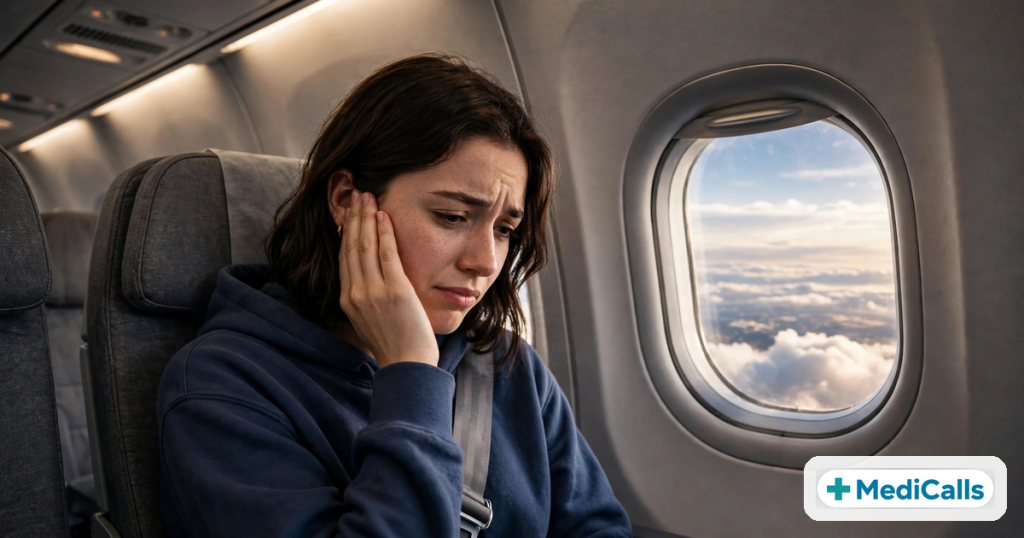
QUICK ANSWER: A blocked ear after a flight is usually just trapped air pressure in your middle ear. Swallow, yawn, or chew gum — and if that fails, try the gentle Valsalva manoeuvre (pinch your nose and blow softly). Most blocked ears clear within minutes to a few hours. Do not force it, and do not poke anything into your ear.
It happens because of pressure. During take-off and especially landing, cabin pressure changes faster than the pressure inside your middle ear can keep up. A narrow tube called the Eustachian tube connects your middle ear to the back of your nose, and its job is to equalise that pressure. When it is swollen from a cold, allergies, or dry cabin air, it cannot keep up — and your ear feels blocked.
Step 1: Swallow, Yawn, or Chew
Start with the simplest tricks. Swallowing and yawning flex the muscles around the Eustachian tube and often pop the ear open on their own. Take a few big, deliberate yawns. Sip water slowly, one swallow at a time. If you have chewing gum or a boiled sweet, chew it — the constant jaw movement works the same muscles.
This alone clears most blocked ears within a few minutes of landing.

Step 2: Try the Toynbee Manoeuvre
If swallowing alone does not work, pinch your nostrils shut, close your mouth, and swallow at the same time. This is the Toynbee manoeuvre, and it gently pulls air through the Eustachian tube. Repeat three or four times, pausing between attempts. A small click or pop means the pressure has equalised — exactly what you want.
Step 3: Try the Valsalva Manoeuvre — Gently
Pinch your nose shut, close your mouth, and blow softly, as if you were trying to pop your ears. You should feel your ears fill slightly, not hurt. Hold for a second or two, then release and swallow. Repeat two or three times.
The key word is gently. Blowing hard can strain the eardrum, so if it hurts, stop immediately.

Step 4: Give It Time, and Keep Swallowing
If your ear is still blocked after the manoeuvres, do not panic. Keep sipping water, yawning, and chewing over the next hour or two. Walking, talking, and eating all keep the jaw moving and help the tube open gradually. For most people, the blockage fades on its own within a few hours of landing.
A warm flannel held against the ear can feel soothing. A standard over-the-counter decongestant nasal spray may help if you have a cold or congestion — follow the pack directions, and do not use it for more than a few days in a row.
Step 5: Help Children Clear Their Ears Too
Children often struggle more, because their Eustachian tubes are narrower. Give a baby a bottle or breastfeed during descent; give an older child water to sip, a snack to chew, or a blowing game like bubbles. If your child is crying and holding their ear after landing, the same swallowing and chewing tricks apply — keep it playful, not forced.
What NOT to Do
- Do not blow hard with your nose pinched — forceful Valsalva can damage the eardrum.
- Do not poke anything into your ear — no cotton buds, ear candles, fingers, or keys. You cannot reach the blockage, and you can injure the ear canal.
- Do not use ear drops unless a doctor has told you to — most post-flight blockage is pressure, not wax, and drops will not fix it.
- Do not ignore it for days — a blockage that lasts beyond 48 hours deserves a check-up (see below).
- Do not fly again with a bad cold if you can avoid it — congestion makes pressure problems far more likely next time.
See a Doctor / Seek Urgent Care If:
- The blockage lasts more than 48 hours, or keeps coming back after every flight.
- You have sharp ear pain, or pain that is getting worse rather than better.
- You notice hearing loss that does not improve, ringing that is new and loud, or dizziness.
- There is fluid, blood, or discharge coming from the ear.
- You had a very painful landing with sudden severe pain or a feeling that something “gave way” inside the ear.
- A child has a fever along with ear pain or discharge after flying.
FAQs
How long does a blocked ear after a flight normally last?
For most people, minutes to a few hours. If you had a cold during the flight, it can take a day or two for the swelling to settle.
Can a blocked ear after flying cause permanent damage?
Almost never. The blockage is trapped pressure, not injury. Damage is rare and usually linked to very forceful blowing or a severe infection already present — which is why gentle manoeuvres matter.
How can I prevent it on my next flight?
Chew gum or sip water during descent, yawn deliberately as the plane comes down, and avoid flying with a heavy cold if possible. If you must fly congested, a decongestant taken before landing (following pack directions) can help.
This guide is for information only and is not medical advice.